Dijkstra's algorithm (/ ˈdaɪkstrəz / DYKE-strəz) is an algorithm for finding the shortest paths between nodes in a weighted graph, which may represent, for example, a road network.
To handle, we use Dijkstra’sAlgorithm - it always picks the node with the least distance first, ensure each node is processed only once, and all its neighbors are explored immediately with the shortest distance for that we use priority queue.
Developed by computer scientist Edsger W. Dijkstra in 1956 and published in 1959, Dijkstra’s algorithm has become a foundational concept in computer science and graph theory. In this tutorial, we’ll explore what Dijkstra algorithm is, how it works, how to implement it programmatically, and more.
Dijkstra's algorithm is used for solving single-source shortest path problems for directed or undirected paths. Single-source means that one vertex is chosen to be the start, and the algorithm will find the shortest path from that vertex to all other vertices.
Dijkstra's Algorithm is one of the most famous algorithms in computer science and graph theory, used to find the shortest path from a starting node to all other nodes in a weighted graph.
“Dijkstra’s Algorithm is a graph search algorithm that is used to find the shortest path between a starting node and all the other nodes in a weighted graph, where all edge weights are non-negative.” It was designed by Dutch computer scientist Edsger W. Dijkstra in 1959.
Dijkstra’s algorithm is a graph search algorithm that solves the single-source shortest path problem for a graph with non-negative edge weights. It was conceived by computer scientist Edsger W. Dijkstra in 1956 and published three years later.
Dijkstra’s Algorithm was introduced by Dutch computer scientist Edsger W. Dijkstra in 1956. It is one of the most popular algorithms in graph theory, used to find the shortest path from a single source to all other vertices in a graph with non-negative edge weights.
At its heart, Dijkstra's Algorithm is a shortest path algorithm designed to find the shortest (or least costly) paths from a single starting node (or "vertex") to all other reachable nodes in a graph.
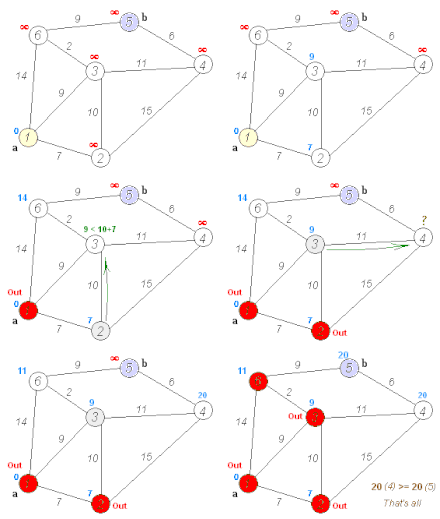 Dijkstra's algorithm (/ ˈdaɪkstrəz / DYKE-strəz) is an algorithm for finding the shortest paths between nodes in a weighted graph, which may represent, for example, a road network.